
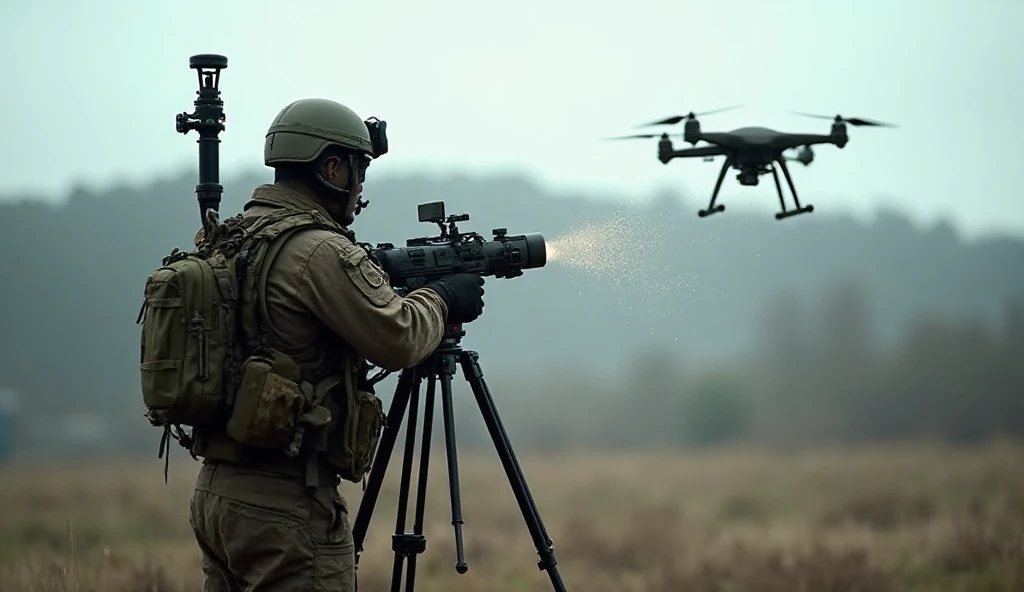
The rapid expansion of unmanned aerial systems has increased the demand for effective, scalable electronic warfare (EW) solutions. Among the most commonly discussed mechanisms are control-link suppression and video-link suppression. Although both methods target different components of the UAV’s communication architecture, their operational value, cost, and complexity differ significantly.
Control-Link Suppression: Accessible, Scalable, Effective
Suppressing a drone’s control link remains the most practical and widely deployed approach in current conflict environments.
Key characteristics:
- Predictable signal structure: Control channels are typically narrowband, stable, and easier to detect and interfere with.
- Lower technological threshold: Effective jamming equipment can be produced at moderate cost.
- Scalability: Suitable for widespread deployment across layered defense systems.
Despite its simplicity, control-link suppression often produces immediate operational effects, significantly degrading the majority of commercial and improvised UAV platforms.
Video-Link Suppression: Technically Demanding and Resource Intensive
Video-link interference requires substantially more sophisticated capabilities.
Key factors:
- Wide operational range: Video downlinks may operate anywhere from 400 MHz to beyond 7 GHz.
- Frequency agility: Modern systems often employ frequency hopping or adaptive spectrum usage.
- High power and precision requirements: Consistent disruption across such a wide spectrum demands advanced, multi-channel EW systems.
As a result, effective video-link jamming is typically associated with high-end, specialized EW assets rather than mass-produced solutions.
Modern Failsafe Behavior Under Jamming
Contemporary UAV platforms implement advanced failsafe logic. When the control link is compromised, the aircraft typically:
- continues executing the last valid command (stick position), or
- attempts a vertical maneuver to regain link stability.
This behavior can reduce the likelihood of accurate target engagement when visibility, maneuvering space, or timing are not ideal.
While highly skilled operators may achieve limited effectiveness in pre-programmed or “blind” approaches, such scenarios are not representative of typical field conditions and require precise alignment and preparation.
Comparative Assessment
Control-Link Suppression
- High operational availability
- Suitable for mass deployment
- Immediate and consistent effect on most UAV types
- Cost-effective first layer of counter-UAS defense
Video-Link Suppression
- High technical complexity
- Limited to advanced EW systems
- Effective against experienced operators
- Best suited as a precision, high-value countermeasure
Both approaches have distinct roles within a comprehensive defensive framework.
Strategic Conclusion
At present, control-link jamming provides the highest return on investment and remains the most justified primary measure for large-scale counter-UAS defense. Its reliability and accessibility make it foundational for frontline EW operations.
However, long-term capability development should focus on integrated EW architectures capable of suppressing:
- control signals,
- video downlinks,
- navigation signals,
- and telemetry channels simultaneously.
A unified system that disrupts all critical links ensures maximum reduction of UAV effectiveness and operator situational awareness, forming the basis of future-proof counter-UAS strategy.